

How to Ski Verbier: A Guide to the Best Runs for Every Ability
Verbier is one of the most exciting ski resorts in the Alps, offering everything from gentle beginner slopes and wide-open cruising pistes to steep descents, moguls and some of the best off-piste skiing in the region.
However, for first-time visitors, knowing where to start can be surprisingly challenging. The ski area has several access points, including Médran, Carrefour and Savoleyres, as well as the slopes around La Chaux and the neighbouring area of Bruson. Choosing the right starting point can make a huge difference to your day.
Verbier’s terrain also varies considerably depending on your ability and the conditions. Some blue runs can feel surprisingly challenging to less confident skiers, while itinerary routes and off-piste terrain require careful consideration of snow conditions, visibility and avalanche risk.
Knowing which runs to choose, where to progress next and how to avoid terrain that is beyond your ability can transform your experience of the mountain.
In this guide, we explore the best skiing in Verbier for every ability, from your first turns on the snow to advanced pistes, fresh powder and exploring the wider 4 Vallées ski area.
-
Best Skiing in Verbier for Beginners
Verbier has several areas where beginners can build confidence and develop their technique, but choosing the right slopes is particularly important during your first few days.
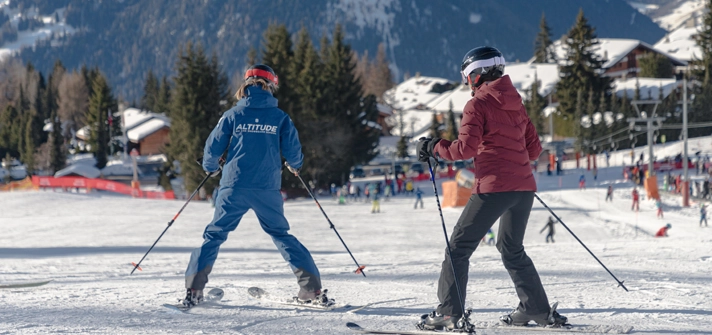
Nursery slopes and your first turns
- Les Esserts: A useful starting point for beginners to practise their first turns and develop their confidence.
- An alternative when snow conditions are poor: The small slope behind the Ruinette restaurant can be a useful option, depending on the conditions and whether it is operating.
The best beginner area can change throughout the season, so it is worth checking the current conditions before heading out.
The best blue runs for progressing
As your confidence improves, you can begin exploring some of Verbier’s easier pistes.
- La Chaux: Offers opportunities to progress onto longer runs. One useful local tip is to take the left-hand slope at the top of the La Chaux 2 chairlift and cut back underneath to avoid the steeper section, where conditions allow.
- Lac des Vaux: A beautiful area to explore, although the initial section of the blue run can feel challenging for someone skiing their first blue piste. It is worth assessing it before committing to the descent.
- Savoleyres: Often a good option for building confidence, with gentler terrain and quieter slopes during some of the busiest periods.
Why a ski lesson can make your first few days easier
The transition from nursery slopes to skiing around an entire resort is not always straightforward. A run that is graded blue may still have steep sections, icy patches or difficult snow conditions.
A private lesson can help you find suitable pistes, avoid unnecessary challenges and develop the skills needed to progress safely. An instructor can also introduce you to the mountain, explain the lift connections and recommend where to ski next.
Altitude Ski School offers private ski lessons in Verbier for different ages and abilities. Your instructor can tailor the session to your goals while helping you discover the best areas for your level.
-
Best Blue Runs in Verbier
Blue runs are not just for beginners. They are also ideal for improving your technique, enjoying the scenery and warming up before tackling more challenging terrain.
The best blue runs for progression
La Chaux and Lac des Vaux can form part of a progression for skiers who are becoming comfortable on blue pistes. The important thing is to choose individual runs according to your confidence and the conditions rather than relying on piste grading alone.
For those who know where to look, there is also a great little blue run on the far right-hand side at the top of the La Chaux 2 chairlift. This can be a useful option for confident beginners and intermediate skiers looking for a quieter alternative, depending on the conditions.
Blue runs with great views
The La Chaux area offers spectacular mountain scenery, including views towards the Petit Combin massif and surrounding peaks. It is a great place to enjoy the landscape while developing your skiing.
Skiing with family and friends of different abilities
Savoleyres offers a variety of terrain that can make it a good choice for families and mixed-ability groups. La Chaux can also work well for groups who want to meet up while stronger skiers explore more challenging nearby pistes.
Planning a day around the right lifts and meeting points can help everyone enjoy the mountain without feeling pressured to ski beyond their ability.
-
Best Red Runs in Verbier
Red pistes offer the next step for confident intermediate skiers who want to improve their technique and explore more of the mountain.
Longer and more interesting pistes
Verbier has plenty of red runs where you can work on linking turns, controlling your speed and adapting your technique to different gradients.
The run from the top of the James Blunt lift back towards the lift is a firm favourite, offering a great opportunity to enjoy the mountain while working on your turns.
The best runs for improving confidence
Moving from blue to red pistes can be a significant step. Rather than simply choosing the steepest run you can manage, look for pistes where you can maintain control and practise consistent turns.
Savoleyres is a good choice for skiers who are becoming comfortable on red runs and want to build their confidence. Its variety of terrain can help you develop your technique without immediately tackling the most demanding slopes.
Snow conditions matter, too. A red piste that feels straightforward in the morning may become more demanding when it is icy, tracked out or covered in heavy afternoon snow.
When to progress to more challenging terrain
If you find yourself relying on skidding or braking throughout a red run, it may be worth spending more time developing your technique before moving on to steeper terrain.
Altitude’s private ski lessons can help you build confidence, while Private Performance Coaching is designed for stronger skiers who want to refine their technique and improve their performance across different types of terrain.
-
Best Black Runs in Verbier
Verbier is famous for its challenging terrain, and its black pistes offer plenty of opportunities for advanced skiers.
What makes a black run difficult?
Steep gradients are only part of the challenge. Narrow sections, bumps, changing snow conditions, ice and visibility can all make a descent more demanding.
A run’s difficulty can change significantly throughout the day and across the season. A piste that feels manageable in good snow may become considerably more challenging when conditions deteriorate.
Which black runs are worth trying?
For confident advanced skiers, Verbier has a number of well-known challenging areas. The Mont Fort and Mont Gelé sectors offer access to demanding mountain terrain, although the precise choice of descent depends on the route, conditions and current lift and piste status.
The aim should be to choose a descent that matches your ability and the conditions rather than simply ticking off the most difficult run.
Why conditions matter
Before tackling a black run, consider visibility, snow quality, crowds and your energy levels. If conditions deteriorate, it may be better to choose an alternative.
For skiers looking to push their limits, a private instructor or guide can help assess the terrain and make better decisions about where to ski. Explore Private Performance Coaching in Verbier if you want to improve your technique on steep slopes, bumps or more demanding pistes.
-
Best Skiing in Verbier for Carving
If you enjoy making clean, controlled turns on groomed pistes, Verbier has plenty to offer.
Where to practise carving
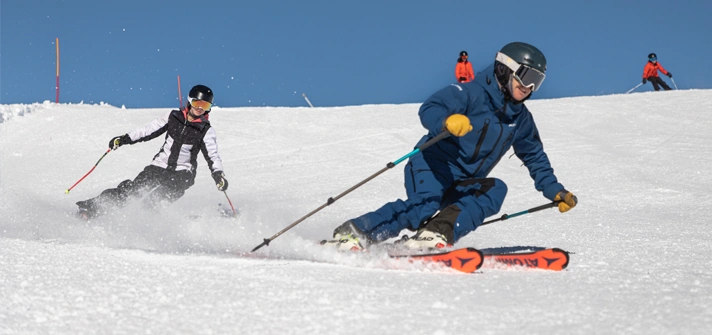
Savoleyres has wide, relatively gentle pistes that can be ideal for developing carving skills and building confidence.
For stronger skiers, steeper pistes can provide a more demanding environment to work on edge control, turn shape and maintaining speed.
Bruson is another excellent option. The snow can often stay firmer here, making it a good choice for carving when conditions are suitable. As always, grooming, temperature, recent snowfall and how busy the slopes are will influence the quality of the skiing.
Why slope choice matters
The best piste for carving is not necessarily the steepest. Look for a slope with enough width, a suitable gradient, good snow and enough space to make turns without putting yourself or others at risk.
Slope traffic is particularly important. Early starts can provide better opportunities to enjoy quieter pistes before they become busy.
Improve your technique with performance coaching
Carving is about more than going faster. Improving your balance, edge engagement, pressure control and turn shape can make your skiing more efficient and enjoyable.
Altitude’s Private Performance Coaching is ideal for skiers who want to refine their technique and get more out of the mountain. Sessions can focus on carving, bumps, powder or steep slopes, depending on your goals.
-
Best Skiing in Verbier After Fresh Snow
Fresh snowfall can transform Verbier, but knowing where to go is essential if you want to make the most of the conditions.
Where to look after snowfall
The best area depends on the snowfall, wind direction, temperature, visibility and avalanche conditions.
Bruson can sometimes offer good options when visibility is poor elsewhere, thanks to its tree-lined terrain. However, tree cover does not make an area automatically safe, and conditions must always be assessed.
Savoleyres may provide alternative options when other sectors are unsuitable, but no area should be considered safe from avalanche risk simply because of its location.
Why wind direction matters
Wind can redistribute snow dramatically, creating wind slabs and unstable snow conditions in some areas while leaving others scoured or exposed.
Understanding the weather leading up to a snowfall can help explain why conditions vary across the mountain. It can also help identify why a seemingly attractive slope may be unsuitable.
Temperature and changing snow conditions
Temperature has a major influence on snow quality. Warmer weather can make lower slopes heavy or slushy, while colder conditions may preserve better snow at altitude.
However, wind, cloud, recent snowfall and lift access can all affect the options available. There is no single area that always offers the best powder.
When to book an off-piste guide
Fresh snow is exciting, but off-piste skiing requires appropriate skills, equipment and an understanding of avalanche hazards.
A qualified guide can help assess conditions, select suitable terrain and explore areas you might not discover independently. A few days after snowfall, local knowledge can also be valuable for finding less tracked snow and choosing the best available conditions.
Altitude offers both Off-Piste Coaching in Verbier and Off-Piste Guiding in Verbier. Coaching focuses on developing your off-piste technique, while guiding is ideal for exploring the mountain and finding suitable terrain.
Off-piste skiing should always be approached with appropriate safety equipment and training. Check the current avalanche bulletin and local conditions, and seek qualified guidance when necessary.
-
Best Skiing in Verbier for Advanced Skiers
Advanced skiers come to Verbier for its steep pistes, challenging moguls, itinerary routes and extensive off-piste opportunities.
Steep terrain
The Mont Fort and Mont Gelé sectors are well known for challenging mountain skiing. The difficulty of individual descents varies, so it is important to check the current route and conditions before setting off.
Moguls
Tortin and the Gentianes–Tortin area are associated with demanding mogul skiing and steep terrain. Bumps can become particularly challenging when they are icy, deep or heavily tracked.
Strong technique and the ability to adapt your turn shape are essential, particularly when the snow is hard or uneven.
Itinerary routes
Verbier’s marked itinerary routes offer a more demanding experience than ordinary groomed pistes. They can include steep slopes, bumps and variable snow, and they may not be groomed or patrolled in the same way as standard pistes.
Check the current status and avalanche information, and make sure the route is appropriate for your ability.
Off-piste skiing
For advanced skiers, Verbier offers a huge variety of off-piste terrain, from more accessible options to steep, technical descents.
The right choice depends on snow stability, visibility, terrain traps, exposure and the group’s experience. Off-piste skiing should be approached with appropriate safety equipment, training and a suitable companion or qualified guide.
Explore beyond the obvious
One of the best ways to discover Verbier’s more adventurous terrain is with a high-mountain guide who knows the area well. Depending on conditions and access, there may be opportunities to explore less familiar descents and more remote terrain, including routes that require specialist knowledge and equipment.
Altitude can help arrange Off-Piste Guiding for suitable terrain, or help organise a high-mountain guide for more technical objectives.
-
Best Places for Lunch While Skiing in Verbier
A good mountain lunch is part of the Verbier experience, and there are plenty of places to stop between runs.
Dahu in La Chaux
Dahu is a firm favourite among the Altitude team. Located in the La Chaux area, it offers good food, a convenient location and beautiful views across the Val de Bagnes.
Its location makes it a useful meeting point for groups spending the day around La Chaux, and the self-service option can be particularly convenient when you want to get back out skiing.
Other mountain restaurants to discover
Verbier and the wider 4 Vallées have plenty of other mountain restaurants worth exploring, from relaxed terraces to longer lunches with spectacular views.
If you are looking for more ideas, read our guide to the Best Restaurants in Verbier, which includes mountain restaurants and options for different tastes and budgets.
The best choice depends on where you are skiing, how much time you have and whether you want a quick break or a more leisurely meal.
-
Explore More of the 4 Vallées
Although Verbier is the best-known resort in the area, it is only one part of the much larger 4 Vallées ski domain.
If you are visiting for a week, exploring beyond Verbier can be a great way to experience different terrain and scenery.
Nendaz
Nendaz offers a different perspective on the ski area, with a variety of pistes and connections into the wider network.
Veysonnaz
Veysonnaz provides access to another side of the 4 Vallées, with terrain that can make an interesting change from Verbier.
Siviez
Siviez is an important connecting point within the ski area and can be a useful base for exploring several sectors.
When should you explore the wider ski area?
A day exploring the 4 Vallées can be a highlight of a week’s skiing, particularly for confident skiers who want to cover more ground.
However, route planning is important. Lift opening times, weather, ability, queues and the time needed to return to your starting point can all affect how much you can realistically explore.
A local instructor or guide can help you choose a suitable route and make the most of your day, especially if you want to explore further afield without worrying about the logistics.
-
Should You Ski with a Guide or Instructor in Verbier?
If you only have a few days in Verbier, knowing where to go can make a huge difference to your experience.
The right choice depends on your ability and what you want to achieve.
Private ski lessons
Private lessons are ideal if you want to improve your technique, build confidence or learn how to ski particular types of terrain.
Your instructor can tailor the session to your ability and help you discover suitable runs as you progress. Private lessons can also be a great way to explore the resort with someone who knows the mountain well.
Find out more about Private Ski Lessons in Verbier.
Private performance coaching
For confident intermediate and advanced skiers, performance coaching focuses on refining technique, improving efficiency and tackling more demanding pistes.
It is particularly useful if you want to improve your carving, develop stronger turns or become more comfortable on steep terrain.
Discover Private Performance Coaching with Altitude.
Off-piste coaching
Off-piste coaching is designed for skiers who want to develop their off-piste skills, including technique, movement and decision-making in variable snow.
It is a great option if you want to improve your powder skiing while exploring Verbier’s off-piste terrain.
Find out more about Off-Piste Coaching.
Off-piste guiding
If your priority is exploring the mountain and finding the best available snow, off-piste guiding may be the right option.
A qualified guide can help select appropriate terrain, assess conditions and introduce you to areas you might otherwise miss.
Explore Altitude’s Off-Piste Guiding in Verbier to find out more.
Make the most of your time on the mountain
Verbier has enough variety to keep skiers of every ability entertained, but choosing the right terrain can make all the difference.
Whether you are learning your first turns, perfecting your carving or exploring challenging off-piste descents, local knowledge can help you make the most of your time on the mountain.
Explore the full range of Altitude Ski School’s lessons and coaching in Verbier to find the right experience for your next trip.


